
Resources
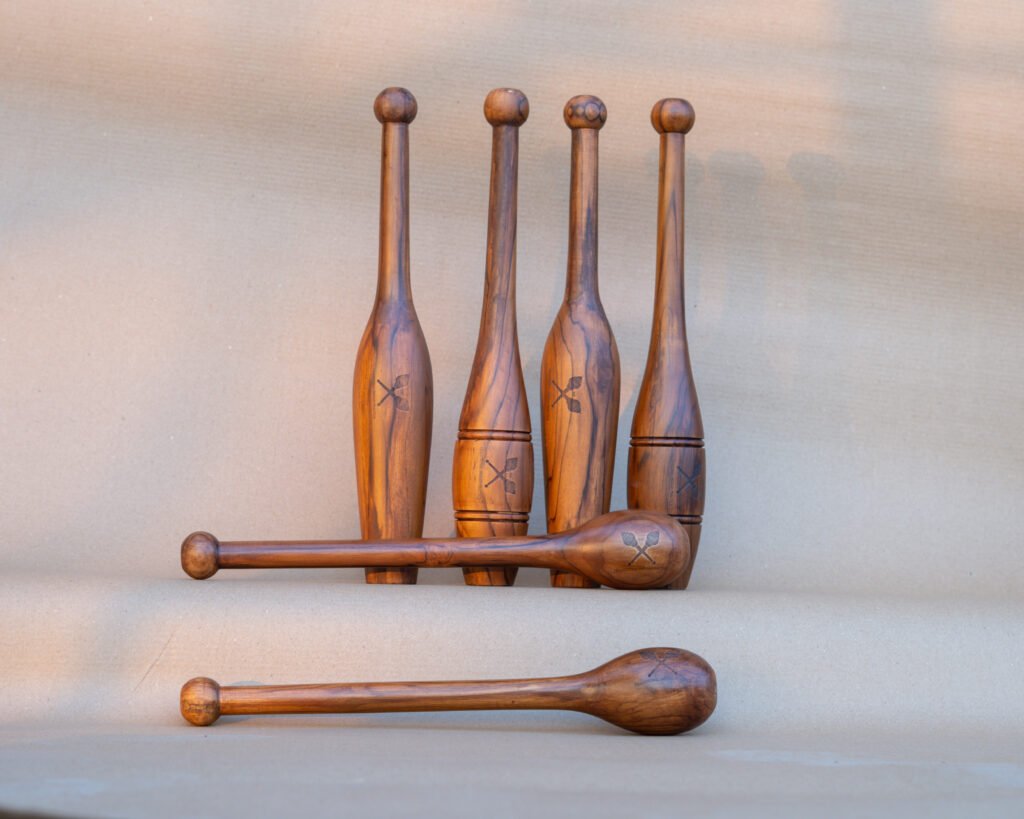
In Hinduism, the Gada (mace or club) is much more than a weapon of war; it is a profound metaphysical symbol representing divine justice (Dharma), sovereign power, absolute righteousness, and deep spiritual intellect. While sharp weapons like swords or arrows pierce or slice, a Gada delivers massive, blunt, structural crushing force. For this reason, it is spiritually used to represent the ultimate destruction of the human ego, ignorance, and Adharma (unrighteousness)
Mundy spent several years in India working for the East India Company. His journals provide a highly detailed
Mundy’s characteristic curiosity led him to closely observe local customs. His encounter with these exercise tools unfolded through specific observations:
1. Observing Military and Wrestling Culture (Akhara)
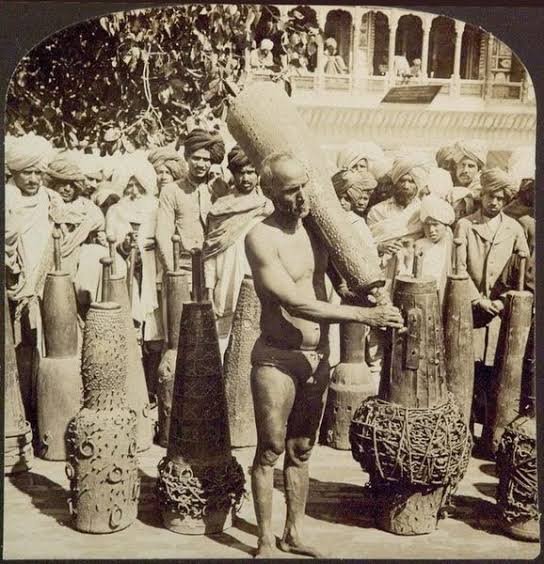
While stationed in places like Surat and Agra, Mundy observed the rigorous training of native soldiers and wrestlers (pehlwans). He visited local traditional gymnasiums, known as akharas. There, he witnessed men swinging heavy, bottle-shaped wooden weights called mudgars (and the larger, mace-like gadas).
2. Documenting the Purpose
In his journal entries from 1630, Mundy noted that the soldiers swung these heavy wooden clubs to harden their bodies, build upper-body strength, and prepare for combat. He was fascinated by how smoothly the exercisers could maneuver such heavy weights around their heads and shoulders, noting that it gave them incredible physical frames and endurance.
3. Sketching and Record Keeping
True to his meticulous nature, Mundy didn’t just write about the clubs; he illustrated them in his manuscripts alongside descriptions of traditional Indian martial arts, sports, and juggling. His drawings and writings became some of the earliest descriptive evidence of the mudgar brought back to the West.
The Legacy of His “Discovery”
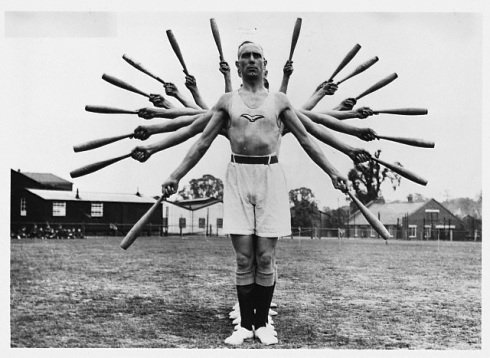
While Mundy introduced the concept to British readers via his journals, it took nearly two more centuries for the British military to fully adopt the practice. In the 19th century, British colonials formally modified the mudgar routines into a lighter regimen, renaming them “Indian Clubs.” The practice then exploded into a global fitness craze, even becoming an official Olympic gymnastics event in 1904 and 1932.
Indian clubs were famously described by Victorian fitness authors and physical educators as the “poetry of motion” because the exercises prioritize fluid rhythm, perfect posture, and visual grace over raw, strained exertion.
Unlike traditional weightlifting, which involves linear, jerky movements (like pushing or pulling), Indian club swinging is entirely circular, continuous, and rhythmic. When practiced correctly, the motion looks more like a choreographed dance or a moving meditation than a brutal workout.
Training with lightweight Indian clubs serves as a form of “mental gymnastics”, bridging the gap between physical conditioning and neurological adaptation. The circular, rhythmic, and multi-planar movements force the nervous system to continuously map and recalibrate body position in real-time.
benifits of using indian clubs trainig
1. Enhanced Bilateral Coordination and Brain Hemispheric Cross-Talk
Swinging clubs forces both hands to execute symmetrical or asynchronous circular paths, heavily stimulating both brain hemispheres.
- The Motor Control Benefit: It develops limb independence and fine-tunes bilateral coordination. Over time, this grooves new neural pathway adaptations, improving complex, multi-limb everyday movements.
- The Nursing & Instructional Change: Shift from unilateral to synchronized, multi-directional tracking. A practitioner or coach must transition a student from basic single-arm front swings to asymmetrical patterns (e.g., one arm swinging clockwise while the other swings counter-clockwise). This forces the brain to process spatial tracking from both sides of the body simultaneously.
2. Heightened Proprioception and Kinesthetic Awareness
Because the weight distribution of an Indian club is heavily concentrated at the bulb end, it creates a dynamic leverage effect that changes constantly throughout the arc of motion.
- The Motor Control Benefit: The shifting center of mass sends continuous sensory feedback through mechanoreceptors in the wrists, elbows, and shoulder joints. This greatly enhances your baseline body awareness and spatial orientation.
- The Nursing & Instructional Change: Shift from visual dependence to tactile-internal focus. Practitioners must be cued to stop staring at the clubs or a mirror to guide their movement. Instructors must prompt the trainee to close their eyes during lightweight, familiar patterns to force the nervous system to rely entirely on muscle spindles and joint receptors to regulate the weight.
3. Dynamic Stabilizer Recalibration (Rotator Cuff & Core)
Unlike traditional linear resistance training (like a bicep curl or bench press), clubs require muscles to transition rapidly between active contraction, elastic stretching, and stabilization.
- The Motor Control Benefit: It grooms the timing of the rotator cuff muscles and the core. The brain learns exactly when to switch on stabilizing muscle groups to protect the joints against changing forces and torque.
- The Nursing & Instructional Change: Shift from isolated muscle cueing to kinetic-chain integration. Instead of instructing a patient to “flex the shoulder,” the instruction changes to cueing the body as a unified structure. The trainer or therapist must focus on the pivot of the feet, the stabilization of the trunk, and the fluid hand-off of power from the hips to the fingertips.
4. Expansion of Controlled Range of Motion (CROM)
Many individuals possess “passive” flexibility (e.g., a physical therapist pushing an arm overhead) but lack the active neurological control to safely move their own limbs through that same space.
- The Motor Control Benefit: Club swinging moves the shoulder joints through their entire three-dimensional spectrum while under continuous, gentle load. This teaches the brain that these extreme positions are stable and safe, converting dangerous passive range into active, controlled mobility.
- The Nursing & Instructional Change: Shift from static stretching to kinetic pathway grooving. Rather than holding a rigid position, the rehabilitation plan changes to fluid “heart-shaped” and “teardrop” swings. This micro-loads the joint dynamically, gently overriding the brain’s protective threat-response system (which usually causes muscle tightness)
5. Reflexive Grip and Forearm Recruitment
The offset balance of the club puts substantial and variable demands on the hand muscles and forearms.
- The Motor Control Benefit: It develops continuous grip regulation. The brain learns to modulate gripping pressure automatically—firming up at the apex of a swing and relaxing slightly during the downward drop—preventing over-fatigue while optimizing hand-eye control.
- The Nursing & Instructional Change: Shift from mechanical gripping to “flow-state” regulation. Instead of telling a patient to clamp down as hard as possible on the handle, coaches must cue the trainee to keep a loose, adaptable grip that allows the club to roll slightly in the hand. This mimics real-world sports and reactive tasks far better than a static, white-knuckled hold.